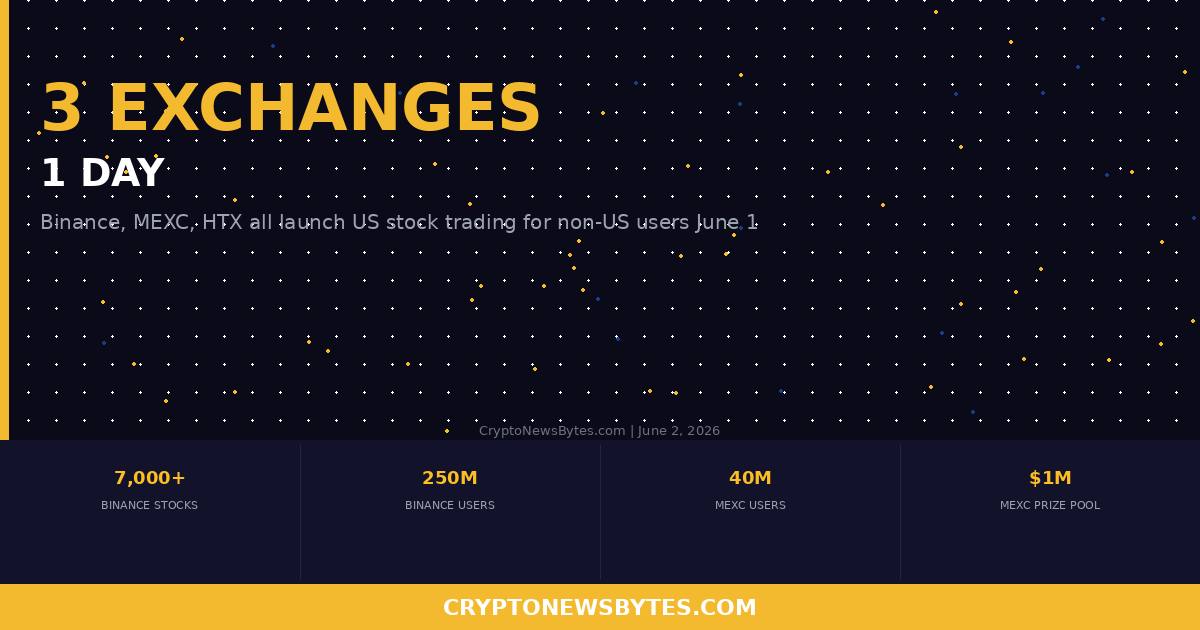
On June 1, 2026, three separate crypto exchanges launched US stock trading products for non-US users on the same day. Binance announced access to more than 7,000 stocks and ETFs commission-free, funded via USDC, USDT, or BNB, through a partnership with Abu Dhabi-regulated Nest Trading and New York-based Alpaca. MEXC launched RealStocks, offering genuine share ownership, zero platform fees, and real dividend payments, funded through USDT, with 20,000 beta users already on the platform. HTX also expanded its Wall Street integration the same day, framing it as breaking time barriers in global finance.
Three exchanges. Same day. Same product category. Same target market: the hundreds of millions of non-US investors who want exposure to US equities but face currency friction, high minimums, and inaccessible brokerage infrastructure. This is not a coincidence. It is a race, and whoever owns the distribution layer for global retail equity access will control one of the most valuable financial infrastructure positions of the next decade.
Binance vs MEXC: How the Products Actually Compare
The surface-level products are similar. Both offer zero commission on US stocks and ETFs. Both support fractional shares from $5. Both fund purchases via stablecoins. Both are restricted to non-US users. The structural differences are meaningful.
Binance routes through two external partners: Nest Trading handles execution and Alpaca handles custody. Binance is the distribution layer and interface. MEXC claims genuine share ownership directly, with real dividend payments in USDT. MEXC CEO Vugar Usi said explicitly that users “truly own world-class traditional financial assets” rather than tracking their price, directly distinguishing RealStocks from synthetic equity products. The distinction between real ownership and synthetic exposure matters for dividend rights, corporate actions, and what happens in an insolvency scenario.
Binance has 250 million users versus MEXC’s 40 million. On distribution alone, Binance wins by a factor of six. But MEXC’s RealStocks was validated by 20,000 beta users before launch and offers a $1 million stock prize pool from June 2 to June 16, a promotional structure designed to drive rapid user activation. The launch incentive economics differ significantly: Binance is relying on brand recognition and its existing user base, MEXC is buying initial trading volume with direct financial incentives.
1. Exchange user base: distribution advantage
Crypto Exchange User Base: Distribution Advantage
Global registered users as of Q1 2026
Binance has 6x MEXC’s user base. Distribution is Binance’s primary advantage over all competitors.
Sources: Exchange official figures | @cryptonewsbytes
2. Product strength: Binance vs MEXC head to head
Binance vs MEXC: Product Strength Comparison
Subjective scoring based on announced features as of June 1, 2026
Sources: Binance, MEXC announcements | @cryptonewsbytes
3. Token performance around launch day
BNB vs MEXC Token: Indexed Price Around Launch Day
May 26 – June 1, 2026 (indexed to 100)
BNB fell ~5% on broader crypto weakness. MEXC token slightly up on RealStocks announcement buzz.
Source: CoinGecko | @cryptonewsbytes
Further Reading
The full Binance structural breakdown: who does what across Nest Trading, Alpaca, and Binance itself.
Traditional finance tokenizing from the top down. Crypto exchanges tokenizing from the bottom up. Same destination.
Coinbase, Binance, and MEXC all launched major market-access products on June 1. The convergence is not coincidental.
This article is for informational purposes only and does not constitute financial advice. Sources: Binance official announcement June 1, 2026; MEXC press release June 1, 2026; Fortune; BanklessTimes; CryptoTimes. Published June 2, 2026.