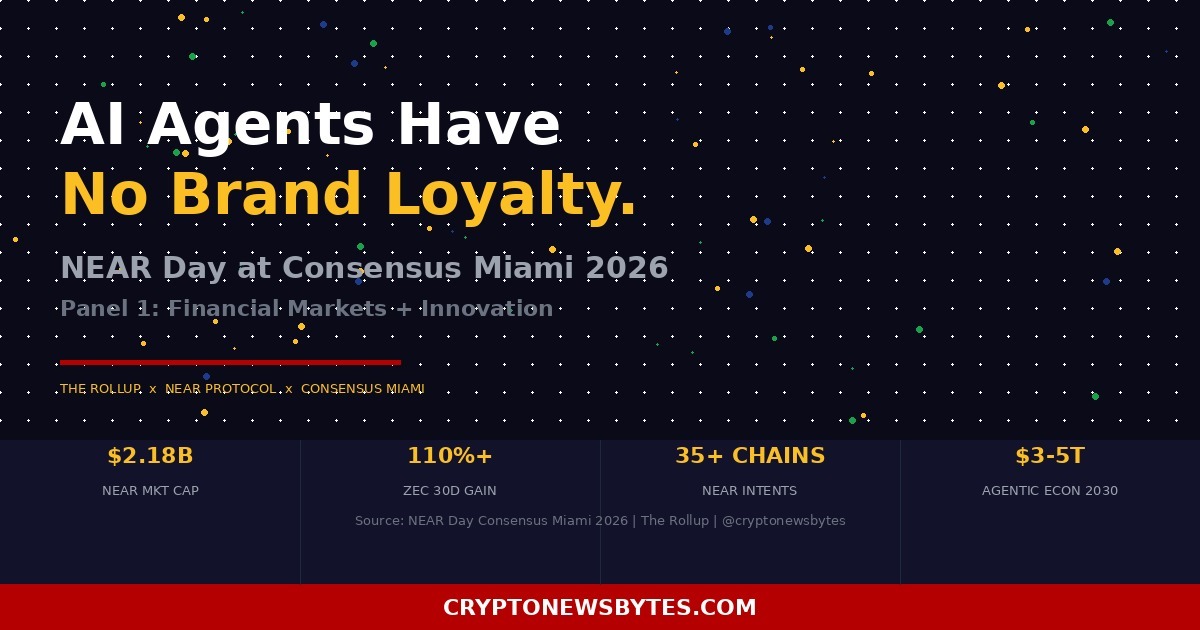
At Consensus Miami 2026, NEAR Protocol hosted a full-day side event that put one argument front and center: AI agents are not going to care about your brand, your UX, or your lobby app. They will route to the cheapest, most secure rails available. And that changes everything about how financial services compete.
The Rollup hosted the event live. What followed across five panels was a dissection of where agentic infrastructure actually stands today: the payments rails that exist, the ones still missing, the custody problems no one has fully solved, and the security benchmarks being built to make any of it trustworthy at scale.
This article covers Panel 1: the opening session on financial markets, innovation, and what the Hyperliquid-Zcash-NEAR cohort tells us about where institutional capital and AI infrastructure are converging.
The Three-Headed Dragon: Hyperliquid, Zcash, and NEAR
The opening panel kicked off with a question that had been percolating across trading desks for weeks: why had Hyperliquid, Zcash, and NEAR emerged as a cohort that seemed to outpace the rest of the market, and what, if anything, did that tell you about where institutional capital was moving?
The moderator framed it as a “three-headed dragon.” The panelists had sharper language for each head. On Hyperliquid: “It was like you took a bunch of engineers, put them in a room, and told them to rebuild financial markets. Ignore regulation. Ignore all the rules.” The speaker acknowledged this would eventually run into a regulatory wall, but credited the innovation as genuinely exciting. On Zcash: the privacy thesis was treated as structural, not speculative. As one panelist put it, any time value moves in and out of a wallet on a transparent chain, it is discoverable. OTC desks already know your wallets by the second trade. That constraint is not going away; it is getting worse as AI-powered analytics improve.
On NEAR: the conversation landed on Intents as the product that finally made chain abstraction legible to a broader audience. The core logic was that users and agents alike just want to state what they want done. The routing, signing, and cross-chain execution should happen underneath. NEAR Intents was described as the first real deployment of that at scale.
The Three-Headed Dragon: What Each Asset Represents
As discussed at NEAR Day, Consensus Miami 2026 | @cryptonewsbytes
| Asset | Core Thesis | Key Risk | AI Agent Relevance |
|---|---|---|---|
| Hyperliquid (HYPE) | Rebuilt financial markets from scratch; fee-generative DEX for perpetual futures | Regulatory wall; competitors copying features | High-performance execution venue for agent trades |
| Zcash (ZEC) | Privacy as infrastructure; zk-SNARKs shield wallet activity from adversarial analytics | Regulator hostility; exchange delistings | Agents need private rails; transparent chains expose strategy |
| NEAR Protocol (NEAR) | Chain abstraction + user-owned AI; Intents handles routing across 35+ chains | Token price lagging ecosystem growth; cross-chain security risks | Native execution layer for AI agents; IronClaw for confidential compute |
Sources: NEAR Day panel transcript, CoinDesk, CoinGecko | @cryptonewsbytes
Why AI Agents Kill Brand Loyalty
The most pointed moment in the opening panel was not about any specific protocol. It was about the economics of customer capture. In traditional finance, switching costs are real: inertia, account setup friction, UI familiarity. Brands spend enormous resources building those moats.
“They don’t give a damn about all the work we put into those things. They’re going to optimize for whatever they’ve been told to optimize for, which is generally going to be cost and security.”
Panelist NEAR Day Panel 1, Consensus Miami 2026
AI agents do not have inertia. They do not care about beautiful branding. They will not feel friction opening a new account. One panelist put it directly: agents will “optimize for whatever they’ve been told to optimize for, which is generally going to be cost and security.” That single sentence is, functionally, a business model threat to every financial institution that has been competing on brand and UX rather than on raw execution quality.
The panel saw this as a forcing function rather than a crisis. Businesses that can genuinely offer the cheapest, most secure execution will gain customers they could never acquire through conventional marketing. The ones that cannot will lose customers they assumed were loyal. Agents only accelerate that sorting.
Privacy as a Three-Layer Problem
One panelist noted they had brought up lack of privacy as a constraint on institutional adoption at a board meeting back in December. The argument was not abstract: whenever a payment is made on a transparent chain, the full wallet history is readable by anyone, including counterparties, competitors, and analytics firms now running AI-powered transaction tracing.
At the same event, Josh Swihart, CEO of the Zcash Open Development Lab, told a separate Consensus Miami audience that Zcash would roll out quantum-recoverable wallets within a month and reach full post-quantum status within 12 to 18 months. Bridges to Solana and Hyperliquid are already live. That context made the NEAR Day panel’s privacy discussion more than theoretical; ZEC up 110% in 30 days is the market pricing that thesis in real time.
NEAR’s approach runs through IronClaw and OpenClaw: confidential computing via Trusted Execution Environments that let AI models process encrypted data without exposing it to the infrastructure provider. The panelist framing was that these three projects, Hyperliquid, Zcash, and NEAR, each represent a different edge of the same problem: efficient execution, private execution, and abstracted cross-chain execution. The market, apparently, had started pricing them as a coherent thesis rather than three separate bets.
Privacy Layer Approaches Discussed at NEAR Day
How each protocol approaches confidentiality for agents and institutions | @cryptonewsbytes
Comparative assessment based on NEAR Day panel discussion and public documentation | @cryptonewsbytes
Who Was on the Panel
The opening panel was moderated by Robbie of The Rollup. The session moved quickly, with contributors including Hunter (referenced as a colleague familiar with the older regulatory constraints in traditional finance) and others from within the NEAR ecosystem side event crowd. The panel closed at the 4:21 mark before Robbie handed hosting to his co-host Matt for the next session.
What stood out was how consensus-heavy the panel was. No one argued that privacy does not matter. No one argued that brand moats survive agentic routing. The disagreement was only about timeline and which protocol gets there first, which is, functionally, a more productive argument than the ones still happening at most industry events.
What Comes Next in This Series
NEAR Day ran five panels across the full day. Panel 1 set the thesis. Panel 2 got into the infrastructure reality: Benjamin Strrisky of the Starknet Foundation, Kendall of Proximity, Nigel from Bridge, and Rich from MoonPay sat down to answer a harder question: who actually pays when AI acts, and what does the plumbing look like today. That coverage is next.
Frequently Asked Questions
What is NEAR Day at Consensus Miami 2026?
NEAR Day was a full-day side event hosted by NEAR Protocol at Consensus Miami 2026, produced by The Rollup. It ran five panels covering financial markets, AI agent payments, agentic applications, institutional custody, and AI security benchmarks.
Why are Hyperliquid, Zcash, and NEAR discussed together?
The three assets outperformed the broader market over the same period heading into Consensus Miami. Panelists framed them as covering distinct but complementary problems: efficient execution (Hyperliquid), private transactions (Zcash), and cross-chain abstraction with AI agent support (NEAR). The market appeared to be pricing them as a coherent infrastructure thesis.
What is NEAR Intents?
NEAR Intents is a cross-chain execution framework where users or AI agents state what they want (for example, swap $100 into the best-yielding stablecoin) and the protocol handles routing, signing, and settlement across 35-plus chains automatically. It reached record daily fees of over $400,000 in late 2025 and was described at NEAR Day as the clearest real-world deployment of chain abstraction.
Why does privacy matter for AI agents specifically?
Agents executing financial strategies on transparent chains expose their logic to any observer. Counterparties can front-run agent behavior or adapt to it once wallet patterns are visible. As AI-powered transaction analytics improve, that risk compounds. Panelists at NEAR Day argued that privacy infrastructure is not optional for any serious institutional AI deployment; it is a prerequisite.
Further Reading
The thesis behind HYPE’s performance and what separates fee-generative DeFi from pure speculation.
Wall Street’s split verdict on the April 2026 bridge exploit that put $246M of Aave debt at risk.
The regulatory framework that would determine whether AI agent finance remains legally viable in the US.
The Solana exploit that preceded Treasury’s OCCIP crypto cybersecurity initiative and refocused the industry on bridge security.
This article is for informational purposes only and does not constitute financial or legal advice. Sources: NEAR Day at Consensus Miami 2026 live stream (The Rollup, May 7, 2026), CoinDesk Consensus Miami coverage, CoinGecko market data, CoinDesk Zcash quantum wallets report. Published May 13, 2026.