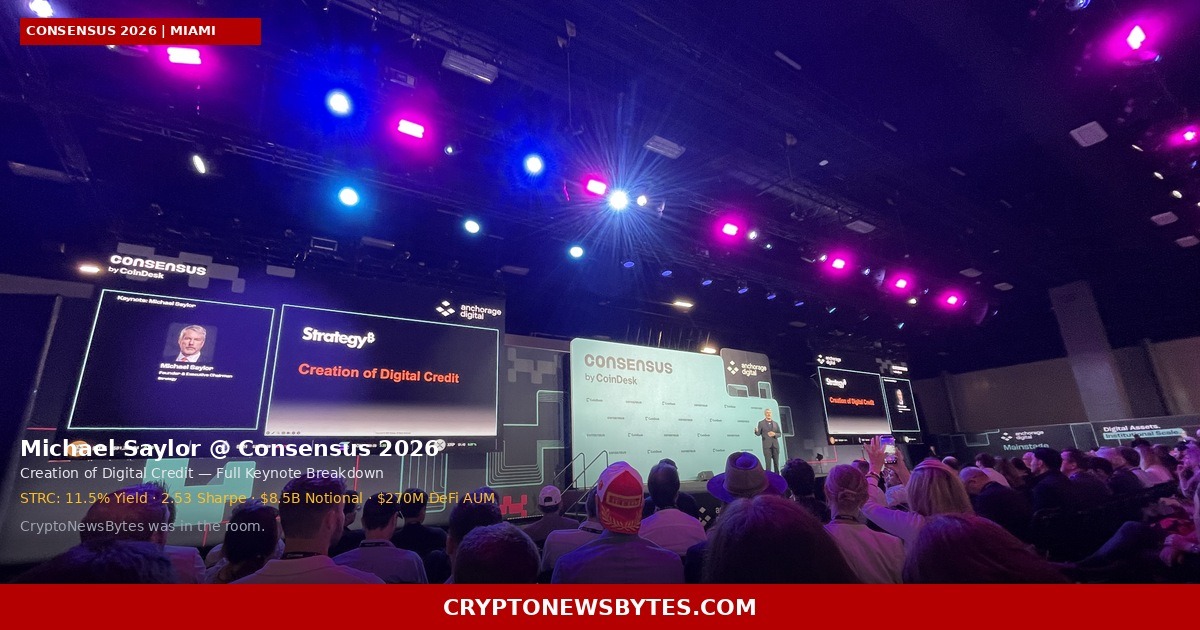
The comparison between Bitcoin and traditional banking has been a theoretical debate for fifteen years. At Consensus 2026 in Miami, Michael Saylor turned it into a data exercise. The numbers on his slides were not projections or models. They were the annualized performance of every major asset class since August 10, 2020, the day Strategy adopted a Bitcoin standard, measured against the same base date with the same methodology.
Bitcoin returned 40% annualized. U.S. bonds returned negative 1%. Bank accounts returned roughly 0.4% in yield with no capital appreciation. The entire traditional fixed-income system, the backbone of how banks store and grow institutional capital, produced negative real returns over the same period that Bitcoin produced its largest sustained institutional adoption cycle.
The Performance Gap No Bank Wants to Present Side by Side
Saylor’s performance slide used August 10, 2020 as the start date because that is when Strategy made its first Bitcoin purchase and adopted what it calls a Bitcoin standard. Since that date, the annualized returns across asset classes are: MSTR at 60%, Bitcoin at 40%, Nasdaq 100 at 18%, S&P 500 at 15%, Gold at 15%, real estate at 6%, money markets at 3%, and bonds at negative 1%. Every single traditional banking instrument sits below Bitcoin. Every single one.
The bond return is the number that deserves the most attention. Bonds are not a fringe product. They are the foundation of how banks, pension funds, insurance companies, and sovereign wealth funds store value. The PIMCO Active Bond ETF, used as the benchmark in Saylor’s slides, returned negative 1% annualized over the same period Bitcoin returned 40%. An institutional investor who allocated to bonds rather than Bitcoin over this window did not just underperform. They lost purchasing power in nominal terms before inflation adjustments.
Asset Class Performance Since Bitcoin Standard: Aug 10, 2020
Annualized returns. Source: Strategy.com as of May 5, 2026
Source: Strategy slides, Consensus 2026 Miami | Photographed by CryptoNewsBytes
The Volatility Argument Is Weaker Than Banks Claim
The standard institutional objection to Bitcoin is volatility. The Saylor volatility slide at Consensus 2026 showed Bitcoin at 41% 1-year historical volatility, compared to Gold at 27%, QQQ at 16%, VNQ at 14%, SPY at 12%, bonds at 4%, and money markets at 1%. Bitcoin is genuinely more volatile than all of them. That is a real number, not a disputed one.
The question Saylor puts to that objection is not whether the volatility is real but whether it justifies the return differential. Gold has 27% volatility and returned 15% annualized. Bitcoin has 41% volatility and returned 40% annualized. You are taking on 1.5 times Gold’s volatility and receiving 2.7 times Gold’s return. The risk-adjusted argument against Bitcoin versus Gold is harder to make than it appears at first contact with the headline volatility number.
Bonds present a different problem. At 4% volatility, bonds look like the stable instrument. But negative 1% annualized return means the stability is not producing value. You are accepting near-zero volatility in exchange for a guaranteed loss of purchasing power in a period of elevated inflation. The risk-free rate argument for bonds collapsed precisely when inflation made it matter most.
STRC vs Bank Preferred Stock: Where the Gap Becomes Embarrassing
The most pointed comparison in the keynote was not Bitcoin versus bonds. It was STRC, Strategy’s Bitcoin-backed preferred stock, versus the preferred stock of the largest banks in the world on a risk-adjusted basis. The Sharpe ratios from Saylor’s slides: STRC 2.53. Bank of America preferred 0.26. JPMorgan preferred 0.22. Citigroup preferred 0.22. Wells Fargo preferred approximately 0.3. STRC’s risk-adjusted return is roughly ten times that of the major bank preferred instruments.
The liquidity comparison adds another dimension. STRC trades at $375 million in average daily volume. JPMorgan’s preferred stock trades at $4 million per day. Bank of America preferred at $16 million per day. Wells Fargo preferred at $15 million per day. STRC has 25 times the daily liquidity of the second-largest tradeable preferred in the world, and roughly 100 times the liquidity of JPMorgan’s preferred. A product backed by Bitcoin has more market depth than the preferred equity of the world’s largest bank by assets.
STRC vs Bank Preferred: Sharpe Ratio and Daily Liquidity
As of May 1, 2026. Data from Strategy keynote slides, Consensus 2026
| Instrument | Sharpe Ratio | Daily Liquidity | Market Cap |
|---|---|---|---|
| STRC (Strategy) | 2.53 | $375M | $8.5B |
| WFC/PL (Wells Fargo) | ~0.3 | $15M | $4.7B |
| BAC/PL (Bank of America) | 0.26 | $16M | $3.7B |
| C/PN (Citigroup) | 0.22 | $4M | $2.7B |
| JPM/PC (JPMorgan) | 0.22 | $4M | $1.9B |
Source: Strategy slides, Consensus 2026 Miami | Bloomberg preferred data as of April-May 2026 | @cryptonewsbytes
What the Data Does Not Prove
The Saylor performance data is real and the comparisons are accurate. But the framing deserves scrutiny. The start date of August 10, 2020 was chosen because it is when Strategy first bought Bitcoin, and it happens to coincide with the beginning of the largest post-COVID risk asset rally in history, a period of near-zero interest rates, massive quantitative easing, and unprecedented retail and institutional inflows into risk assets. Bitcoin’s 40% annualized return from that specific starting point benefited enormously from that macro backdrop in a way that bonds, which were destroyed by the 2022 rate hiking cycle, did not.
That does not make the numbers wrong. It means the comparison window includes a period that was nearly maximally favorable for Bitcoin and maximally unfavorable for fixed income. A period starting in 2018, or 2022, or mid-2021 would produce meaningfully different relative returns. The data Saylor presented is accurate for the period chosen. Institutional investors considering Bitcoin allocation should run the same comparison across multiple time windows before drawing portfolio conclusions.
What the data does prove is that the reflexive institutional dismissal of Bitcoin as too volatile for serious consideration is increasingly hard to sustain against the actual performance record. Whether the next five years replicate the last five is genuinely unknown. That Bitcoin’s last five years have been categorically different from every traditional banking instrument is not in dispute.
Bitcoin vs Traditional Assets: Four Key Comparisons
All data from Strategy’s Consensus 2026 keynote slides. Source: Strategy.com, Bloomberg, FRED as of May 5, 2026 | @cryptonewsbytes
1. Annualised returns since Aug 10, 2020
2. Return vs volatility (bubble size = relative Sharpe)
3. Sharpe ratio: STRC vs banks, hedge funds, bonds
4. Tax-equivalent yield: STRC vs traditional instruments
Source: Strategy keynote slides, Consensus 2026 Miami. Past performance is not indicative of future results. Not financial advice. CryptoNewsBytes was in the room. | @cryptonewsbytes
Further Reading
The complete 12-slide keynote breakdown with all STRC data points and the yieldcoin ecosystem.
The week Saylor delivered this keynote, Strategy also announced its latest $2B Bitcoin purchase. The machine is not slowing down.
Even JPMorgan is now building Bitcoin-adjacent infrastructure. The traditional banking response to the data Saylor presented is not to argue with it.
This article is for informational purposes only and does not constitute financial advice. All performance data sourced directly from Strategy’s presentation slides at Consensus 2026 by CoinDesk, Miami, May 18, 2026. Past performance is not indicative of future results.