
TL;DR
▶ The total stablecoin market has grown from $27 billion at end-2020 to $303 billion in September 2026, a nearly 12x increase in five years.
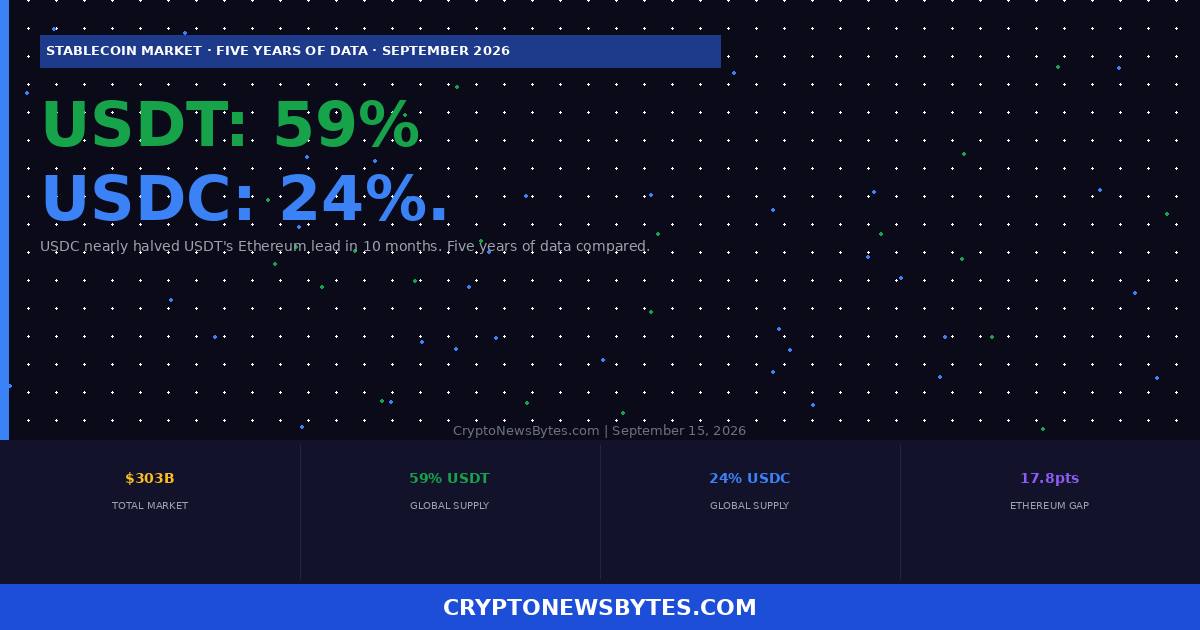
▶ USDT still leads globally at 59% of total stablecoin supply ($183B) but its dominance has fallen from 70%+ in 2021. USDC holds 24% ($74B).
▶ On Ethereum specifically: USDT holds 49.6% vs USDC 31.8% as of September 2026. That gap was 34.2 points in November 2024. Now it is 17.8. Nearly halved in under a year.
▶ USDC grew 83% on Ethereum since November 2024 vs USDT’s 22%. USDC added $21.3B to Ethereum, accounting for 45% of all net new Ethereum stablecoin supply.
▶ The biggest storyline: USDC overtook USDT by transaction volume in 2025, processing $18.3 trillion vs USDT’s $13.3 trillion, despite still trailing by supply.
▶ The rising challengers: USDS, USDe, PYUSD, USD1 are collectively growing fast. The mid-tier exceeded $30 billion in 2026 for the first time.
Five years ago, the stablecoin market was a duopoly in all but name. Tether’s USDT held roughly three-quarters of all stablecoin supply and Circle’s USDC was a distant second, relevant mostly to US institutional players and DeFi protocols that valued its regulatory clarity. The total market was $27 billion. Today that number is $303 billion, an almost twelvefold increase, and the market structure has changed in ways that are more interesting than the headline supply numbers suggest.
The CoinMarketCap data point that prompted this analysis is specific to Ethereum: USDC has nearly halved USDT’s lead on the network since November 2024. USDT held 49.6% of Ethereum’s stablecoin supply in September 2026 versus USDC’s 31.8%, a gap of 17.8 percentage points. In November 2024, that same gap was 34.2 points. The narrowing happened almost entirely because USDC grew faster on Ethereum, not because USDT left. Total Ethereum stablecoin supply is 47% higher than it was in November 2024. USDT supply on Ethereum grew 22%. USDC supply on Ethereum grew 83%.
But the Ethereum picture is only part of the story. USDT’s global dominance remains intact at 59% of all stablecoin supply. It dominates Tron, the second-largest stablecoin chain, where it holds 98% of supply. And it still handles more exchange trading volume than any other stablecoin. The real shift in 2025 and 2026 is not that USDT is declining. It is that USDC is growing into new roles, particularly institutional settlement, regulatory-compliant DeFi, and agentic payments, where USDT’s structure makes it less suited. This article covers five years of data on both.
Five Years of Stablecoin Supply: The Complete Data Picture
Total Stablecoin Market Cap: 2020 to September 2026
Sources: DefiLlama, Transak/CoinLaw, StablecoinBeat, CoinDesk Data | @cryptonewsbytes
| Period | Total Market | USDT | USDC | USDT Share | USDC Share | Key Event |
|---|---|---|---|---|---|---|
| End 2020 | $27B | ~$21B | ~$4B | ~76% | ~14% | USDC launched 2018; DeFi boom begins |
| End 2021 | $163B | ~$78B | ~$42B | ~48% | ~26% | Bull market peak; USDC gains institutional ground |
| End 2022 | $138B | ~$66B | ~$45B | ~48% | ~33% | Terra/LUNA collapse; BUSD/FRAX decline; USDC grows |
| Jan 2023 | $137B | ~$68B | ~$43B | ~49% | ~30% | Post-bear trough; USDC SVB incident ahead |
| End 2023 | $130B | ~$91B | ~$25B | ~70% | ~19% | SVB froze USDC reserves briefly; USDC lost share |
| End 2024 | $206B | ~$137B | ~$45B | ~67% | ~22% | USDC recovery begins; GENIUS Act talks start |
| End 2025 | $308B | ~$184B | ~$73B | ~60% | ~24% | USDC overtakes USDT in annual TX volume |
| Sep 2026 | ~$303B | ~$183B | ~$74B | ~59% | ~24% | Clarity Act Senate vote; stablecoin regulation advancing |
Sources: DefiLlama (primary), Transak stablecoin market cap report June 2026, CoinLaw stablecoin statistics, StablecoinBeat September 2026, CoinGecko 2023 report, IMF Crypto Assets Monitor | @cryptonewsbytes. Historical figures are rounded estimates from multiple sources.
The Ethereum Race: How USDC Almost Halved USDT’s Lead in 10 Months
The most striking data point in the current stablecoin landscape is not the global supply split. It is what happened specifically on Ethereum in the ten months between November 2024 and September 2026. In November 2024, USDT held approximately $67.5 billion on Ethereum and USDC held approximately $23.5 billion. USDT’s lead was 34.2 percentage points.
By September 2026, USDT’s Ethereum supply had grown to approximately $82.9 billion, a 22% increase. USDC’s Ethereum supply had grown to approximately $50.8 billion, an 83% increase. Total Ethereum stablecoin supply expanded 47% over the same period. USDC accounted for roughly 45% of all net new stablecoin supply on Ethereum during that ten-month window. The gap fell from 34.2 points to 17.8.
The narrowing continued in 2026 for a second reason beyond USDC’s growth: USDT supply on Ethereum actually fell 15.5% in 2026 while USDC supply on Ethereum fell only 2.9%. More than $7 billion of USDT left Ethereum in Q1 2026 alone, the largest quarterly USDT outflow from Ethereum on record. This USDT outflow was largely offset by USDC and yield-bearing stablecoin growth on the same chain, suggesting users rotated within the Ethereum ecosystem rather than exiting it.
USDT vs USDC: Ethereum Stablecoin Share, November 2024 to September 2026
Sources: CoinMarketCap, CoinLaw, Stablecoin Insider | @cryptonewsbytes
Note: Bar widths are relative for visual comparison only. Source: CoinMarketCap, Stablecoin Insider, CoinLaw | @cryptonewsbytes. Not financial advice.
The Transaction Volume Flip: Where USDC Already Won
Supply numbers are only one way to measure stablecoin dominance. By annual transaction volume, USDC overtook USDT in 2025, a development that received far less attention than the supply gap. According to Artemis data reported by Bloomberg, USDC processed $18.3 trillion in adjusted transaction volume in 2025 versus USDT’s $13.3 trillion, a 38% advantage despite USDC trailing USDT in supply by nearly 3 to 1.
The explanation is where USDC gets used versus where USDT gets used. USDT dominates trading on centralised exchanges, particularly in Asia, and on Tron, where it processes high-volume payment flows. CEX trading volume is large in nominal terms but each dollar turns over many times representing the same underlying demand. USDC dominates DeFi on Ethereum, institutional settlement flows, and agentic payments. Ethereum DEX volume is 80% USDC by dollar value. Agentic payments, the emerging category of machine-to-machine AI agent transactions, settle 98.6% in USDC. These transaction categories turn over less frequently but represent genuine economic activity.
The volume flip means the two stablecoins are winning in different markets. USDT is the stablecoin of speculative trading and retail payments in emerging markets. USDC is the stablecoin of DeFi, institutional settlement, and regulatory-compliant infrastructure. Both are growing. The question of which has “won” depends entirely on which use case you consider more valuable.
Why USDC Grew So Fast: Five Specific Reasons
The SVB rebound
In March 2023, Silicon Valley Bank failed while holding $3.3 billion of USDC’s reserves, briefly breaking USDC’s dollar peg to $0.87. Circle resolved the situation within days when the US government backstopped SVB depositors, but USDC lost roughly $15 billion in supply and significant market share during 2023. From the $25 billion low at end-2023, USDC recovered to $74 billion by September 2026, a 196% rebound. The SVB incident, despite being terrifying in the moment, ultimately demonstrated that USDC’s reserve structure was sound and Circle’s relationship with US regulators was solid.
The GENIUS Act and regulatory clarity
The GENIUS Act, which advanced toward passage in 2026, creates a formal federal licensing framework for stablecoin issuers in the United States. USDC is positioned to be among the first issuers to comply with that framework. As regulatory clarity increased, institutional participants who had been hesitant to hold or use unregulated stablecoins shifted preference toward USDC. The $21.3 billion USDC added to Ethereum in the ten months through September 2026 correlates directly with the period when GENIUS Act passage became increasingly likely.
DeFi protocol preferences
Ethereum’s DeFi ecosystem has increasingly standardised on USDC for its higher-value operations. Aave, Compound, MakerDAO (now Sky), and Uniswap v4 all use USDC as a primary collateral and liquidity denomination. USDC accounts for approximately 80% of Ethereum DEX stablecoin volume. As DeFi TVL expanded in 2025, USDC captured the majority of the growth in stablecoin collateral.
Institutional clearing and Base
Coinbase’s Base network, which processes significant institutional and retail USDC flows, grew dramatically in 2025 and 2026. Base accounts for approximately 6.1% of USDC usage by network. The combination of Coinbase’s institutional distribution network and Base’s growing DeFi ecosystem created a flywheel that pulled more USDC into circulation.
Agentic payment infrastructure
98.6% of AI agent payments settle in USDC, not USDT. While the volume remains small in absolute terms ($8 billion projected for 2026), this is the fastest-growing payment category in the stablecoin market. USDC’s positioning as the default for machine-to-machine economic activity represents a structural advantage in the fastest-growing vertical.
Why USDT Is Still Winning and Will Not Collapse
The Tron fact that changes everything
USDT on Tron holds approximately $78 billion in supply with 343 million user accounts. Tron processes over $78 billion in circulating USDT stablecoins and accounts for roughly 60% of real-economy USDT payment flows. The Ethereum stablecoin story is a battle USDC is winning. The global stablecoin story, including Tron, is still dominated by USDT by a wide margin. Ethereum-based analysis systematically understates USDT’s actual scale because Tron is invisible in Ethereum-focused data.
USDT’s 59% global supply share obscures its actual transaction dominance in the markets it serves. USDT accounts for approximately 74% of stablecoin trading volume on centralised exchanges, higher than its supply share, meaning it turns over faster on exchanges than USDC does. In emerging markets across Southeast Asia, Latin America, and Africa, USDT functions as a de facto digital dollar alternative to banking, largely through Tron. That market does not require regulatory compliance, DeFi integration, or institutional-grade settlement infrastructure. It requires low fees and wide availability, which Tron provides.
Tether’s business model also generates extraordinary profits in the current interest rate environment. Tether holds US Treasury bonds as reserves for its $183 billion supply. At current yields, that represents approximately $9-10 billion in annual interest income with near-zero operating costs, since Tether does not pay interest to USDT holders. That revenue base makes Tether one of the most profitable financial entities per employee in the world, and gives it permanent structural advantages in sustaining its supply and defending its market position.
The Rising Challengers: Who Else Is in the Race
Stablecoin Market Beyond USDT and USDC: The Challengers (September 2026)
Sources: DefiLlama, CoinLaw, CoinMarketCap September 2026 | @cryptonewsbytes
| Stablecoin | Supply | Issuer | What Makes It Different |
|---|---|---|---|
| USDS | ~$9B | Sky (MakerDAO) | Yield-bearing. Earns Dai Savings Rate automatically. DeFi-native replacement for DAI. |
| USDe | ~$3.8B | Ethena | Delta-neutral synthetic dollar backed by ETH staking yield and short perpetual positions. ~8-14% native yield. |
| PYUSD | ~$2.9B | PayPal / Paxos | 400M+ PayPal users as distribution. Grew 600% in 2025. Ethereum and Solana native. |
| USDY | ~$1.5B | Ondo Finance | Tokenized US Treasury yield-bearing dollar. Institutional RWA focus. Regulated. |
| USD1 | ~$1.2B | World Liberty Financial (Trump-backed) | Launched 2026. Political distribution. UAE sovereign wealth fund early partner. |
| BUIDL | ~$1.2B | BlackRock / Securitize | Tokenized US Treasury money market fund on Ethereum. Institutional access only. |
Note: Mid-tier stablecoins collectively exceeded $30 billion in 2026 for the first time. The common theme: yield. USDT and USDC pay 0% to holders. Yield-bearing alternatives keep the dollar peg while passing interest rate returns to holders. | @cryptonewsbytes
The yield problem USDT and USDC face
USDT and USDC pay 0% interest to holders. Tether and Circle keep the yield from the Treasury bonds backing their supply. In a zero-interest-rate environment this did not matter. With 5%+ Treasury yields available from 2022 through 2025, holding non-yielding stablecoins meant giving up real returns. USDS, USDe, USDY, and BUIDL all offer yield in exchange for holding. The mid-tier grew from near zero to $30 billion partly because yield-seeking institutional and DeFi users rotated from USDT and USDC. If interest rates decline significantly, this pressure on USDT and USDC from yield-bearing alternatives will ease.
What the GENIUS Act and CLARITY Act Mean for the Race
The regulatory environment advancing through the US Senate in 2026 will reshape the stablecoin market in ways that are not yet fully priced. The GENIUS Act CNB has covered creates a federal licensing framework for payment stablecoin issuers. Circle has positioned USDC for compliance. Tether faces more uncertainty.
The GENIUS Act requires stablecoin issuers with more than $10 billion in supply to obtain federal licensing, hold reserves in specific approved instruments, submit to regular audits, and comply with AML and sanctions screening requirements. Circle already meets most of these requirements. Tether, domiciled in the British Virgin Islands with reserves historically held through non-US custodians, faces a harder compliance path. If the GENIUS Act passes and Tether cannot or does not obtain a federal license to operate in the US, USDT would face restrictions in US-regulated financial infrastructure.
This regulatory asymmetry is one reason institutional participants are increasing USDC allocations even before the GENIUS Act passes. Building in regulatory optionality by holding the stablecoin already structured for compliance is rational risk management. The CLARITY Act framework adds further context: as crypto assets gain clearer legal classifications, the stablecoins integrated into the compliant infrastructure of that system stand to capture regulatory tailwinds that alternatives cannot.
Frequently Asked Questions
What is the difference between USDT and USDC?
Both are USD-pegged stablecoins but they differ in issuer, reserve structure, regulatory approach, and primary use cases. USDT is issued by Tether, domiciled in the British Virgin Islands, with reserves in US Treasuries and other instruments. It dominates CEX trading volume and Tron-based payments. USDC is issued by Circle, a US company, with reserves held in US Treasury bills and cash at regulated US financial institutions. It dominates DeFi on Ethereum, institutional settlement, and is positioned for US regulatory compliance under the GENIUS Act.
Why is USDC growing faster than USDT on Ethereum?
Five specific factors: the SVB rebound after USDC lost market share in 2023 and then recovered; regulatory clarity from the GENIUS Act positioning USDC for institutional adoption; DeFi protocol preferences on Ethereum that standardise on USDC for collateral and liquidity; Coinbase’s institutional distribution network and Base’s growing DeFi ecosystem; and USDC’s dominance in agentic payments where 98.6% of AI agent transactions settle in USDC.
Does USDC pay interest to holders?
No. Standard USDC held in a wallet or exchange account earns 0% interest. Circle keeps the yield from the Treasury bills backing USDC’s reserves. This is the same for USDT. Yield-bearing alternatives like USDS, USDe, USDY, and BUIDL pay varying rates of return to holders. The mid-tier of yield-bearing stablecoins grew from near zero to over $30 billion in 2026 partly because of this difference.
What happened to USDC during Silicon Valley Bank’s collapse in 2023?
Circle held approximately $3.3 billion of USDC’s reserves at Silicon Valley Bank when it failed in March 2023. This briefly broke USDC’s dollar peg to approximately $0.87 before the US government backstopped SVB depositors and Circle clarified that its reserves were intact. USDC lost roughly $15 billion in supply and significant market share during 2023 as a result, dropping from a peak of $56 billion to approximately $25 billion by year-end. It has since recovered to approximately $74 billion.
What will the GENIUS Act do to stablecoins?
The GENIUS Act creates a federal licensing framework for payment stablecoin issuers with more than $10 billion in supply. Requirements include federal licensing, specific reserve instruments, regular audits, and AML/sanctions compliance. Circle has positioned USDC for compliance. Tether faces a harder compliance path given its non-US domicile and historical reserve structure. If Tether cannot obtain a federal license, USDT could face restrictions in US-regulated financial infrastructure, which would accelerate institutional preference for USDC.
Is USDT or USDC bigger?
USDT is larger by supply: approximately $183 billion versus USDC’s $74 billion as of September 2026. USDT holds 59% of global stablecoin supply versus USDC’s 24%. However, USDC overtook USDT by annual transaction volume in 2025, processing $18.3 trillion versus USDT’s $13.3 trillion, because USDC is used more heavily in high-velocity DeFi and institutional settlement flows. The answer depends on which metric you use.
Further Reading
The regulatory framework advancing today that could reshape stablecoin market structure: GENIUS Act provisions that create compliance advantages for USDC and potential headwinds for USDT in US-regulated infrastructure.
The institutional RWA tokenization push that is partly driving USDC adoption: as tokenized Treasuries and institutional settlement move on-chain, USDC is the primary cash-equivalent denominator.
The global picture: India chose its own sovereign digital rupee for bond settlement rather than USDT or USDC. A reminder that the stablecoin race is being run in parallel with CBDC development across G20 economies.
Sources: CoinMarketCap stablecoin data September 2026 (primary), DefiLlama on-chain supply (primary, via CoinLaw and Transak), StablecoinBeat September 10 2026 (primary: USDT $183.4B USDC $74.2B), CoinLaw stablecoin market share by chain statistics 2026, Stablecoin Insider liquidity report 2026 (USDT Ethereum outflow data), Transak stablecoin market cap report June 2026 (historical growth table), Artemis via Bloomberg (USDC $18.3T vs USDT $13.3T annual volume 2025), CoinGecko stablecoin statistics report 2023, IMF Crypto Assets Monitor 2024, Coinbase Institutional research USDC resurgence February 2024, Spark Money stablecoin supply analysis 2026 | Published September 15, 2026 | CryptoNewsBytes.com | Not financial advice.